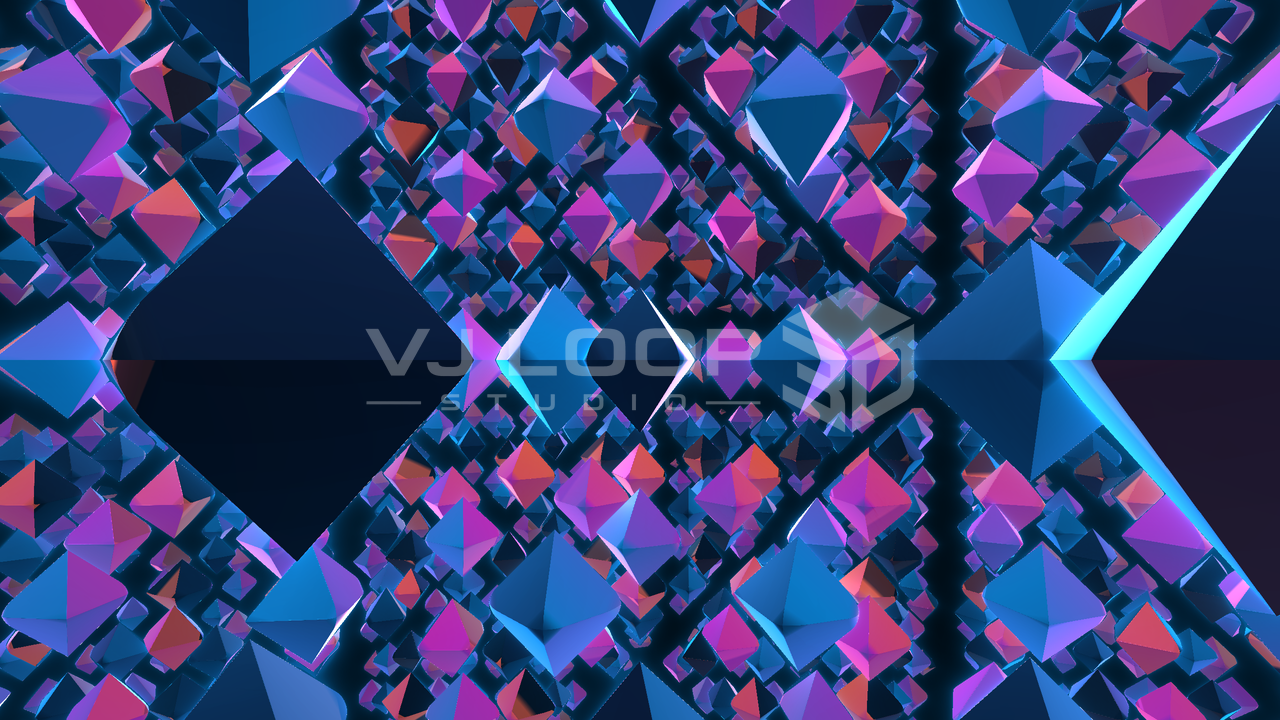
These are the effects where the app is doing real 3D rather than drawing a clever pattern. Each describes a shape as a distance function and walks a ray into it, so the lighting, perspective, and occlusion are genuine. They cost more per pixel than the tunnels and stage effects, and they look it.
Raymarched effects at a glance
| Catalogue | 124 effects total, across eight groups |
|---|---|
| Covered here | Fractal Cosmos, Box Fold Dimension, Blob Fusion, Crystal Dimension, Quantum Grid, Organic Fluids, Tron Organic, Retro Sphere |
| Rendering | Signed-distance raymarching on the wgpu pipeline, with PBR lighting |
| Cost | Higher than the screen-space effects — use Performance Mode or a preview-quality drop while editing |
| Looping | Seamless; motion derives from loop phase, not wall-clock time |
Fractals
Fractal Cosmos
A kaleidoscopic fold — box fold plus ball fold — applied in the wall space of a tunnel, so the corridor you fly down is itself a fractal. Depth scrolls the fold rather than scrolling a texture, which is why detail keeps appearing at every scale as you approach instead of just getting bigger.
The orbit trap drives the shading: banded shells where the orbit stayed close, sparse points where it escaped immediately, which read as distant stars.
Key parameters: Fold Iterations (structure density), Fold Scale and Fold Offset (the character of the fractal — small changes here transform it completely), Shell Glow, Starfield.
Box Fold Dimension
A Mandelbox: a solid built by iterating a box fold and a ball fold in 3D, with a running derivative that keeps the result a usable distance estimate. It turns in space as a single object rather than being flown through.
Key parameters: Fold Scale (negative values give the classic inside-out Mandelbox; positive ones a very different solid), Inner Radius, Box Limit, Iterations, Camera Distance.
Worth knowing: Fold Scale is the parameter with the widest effect. Sweeping it from −2.5 to 2.5 walks through several entirely different solids, and it is a good candidate for a slow modulator.
Geometry and material
Blob Fusion
Metaballs on tilted orbits, merged with a smooth minimum. The blend is the whole effect — a plain minimum gives spheres touching, while blending the transition produces the meniscus that makes them read as one body of liquid pulling itself apart and back together.
Key parameters: Fusion (low values keep them separate, high values merge everything into one mass), Blob Radius, Orbit Radius, Surface Ripple.
Turn Metallic up and Roughness down for chrome; reverse both for something closer to wax or resin.
Crystal Dimension
A lattice of faceted shards, each an octahedron cut by a rotated prism so the facets are irregular rather than die-like. Every cell hashes its own rotation and size from its coordinates, so no two neighbours present the same face.
Refraction is approximated by sampling the palette along the refracted direction rather than tracing a second ray — it gives the hue separation glass is read by at a fraction of the cost.
Key parameters: Lattice Spacing, Shard Size, Facet Count, Refraction Tint, Caustic Glow, Edge Bevel.
For an LED wall, raise Lattice Spacing so there are fewer, larger shards. A dense field of small facets is exactly the detail a coarse pixel pitch cannot resolve.
Fields and surfaces
Quantum Grid
Circular waves from several moving sources, superposed. Where crests meet the sum is large; where a crest meets a trough they cancel. The squared amplitude is what gets drawn, so cancellation is dark on both sides of zero, and an anti-aliased lattice sits over the top with the field quantised into its cells.
Key parameters: Wave Sources, Wavelength, Grid Density, Cell Collapse (0 = smooth field, 1 = fully quantised into the grid), Uncertainty.
Organic Fluids
Domain warping: sample noise, use the result to displace the coordinate, sample again. One pass gives billowing; two gives the folded, sheared structure a liquid actually has. The warp vector doubles as a surface gradient, which drives both the sheen and the thin-film iridescence.
Key parameters: Domain Warp, Warp Passes, Viscosity (thick fluids hold broad plateaus with tight transitions), Iridescent Film, Film Bands.
Tron Organic
A corridor whose wall is displaced by a low-frequency noise field, so it bulges and breathes like something grown — with a hard circuit grid applied as shading on top, complete with a data pulse running down the traces. The contrast between the soft body and the synthetic grid is the point.
Key parameters: Organic Swell, Circuit Density, Trace Glow, Data Pulse, Breathing.
Retro Sphere
A chrome sphere over a scrolling horizon grid. Deliberately the cheapest of this set: the sphere’s normal is reconstructed analytically instead of marched, and the ground is a direct perspective projection, so it stays in the light tier despite looking like a 3D scene.
Key parameters: Grid Density, Horizon Height, Sphere Size, Chrome Bands, Sun Glow, Horizon Haze.
Performance
These are the heaviest effects in the catalogue. Three things help:
- Drop preview quality while editing. It changes the preview only; export is unaffected.
- Turn on Performance Mode in the Live Console when the GPU is also driving a live output or an encoder.
- Keep iteration counts honest. Going from 7 to 14 iterations on a fractal roughly doubles the cost and usually adds detail finer than the display can show.
For a live set, put one of these on a scene you launch deliberately rather than running it for the whole show alongside everything else.
Using them in a set
They are contrast, not backbone. A set built entirely on raymarched geometry is exhausting to watch and expensive to run. The pattern that works:
- Corridors carry the bulk of the set — see the neon tunnel guide.
- A crystal or fractal shot marks a section change, because the shift from flat neon to lit geometry is instantly legible.
- A fluid or field shot covers breakdowns, where slow motion suits the music.
Frequently asked questions
- What is a raymarched effect?
- Instead of drawing a pattern across the screen, the shader describes a shape as a mathematical distance function and walks a ray from the camera until it hits the surface. That gives genuine 3D: real lighting, real perspective, real occlusion. It costs more per pixel than a screen-space effect, which is why these sit in their own tier.
- Which of these are heaviest on the GPU?
- Box Fold Dimension and Crystal Dimension are the most expensive — the first iterates a fractal fold up to sixteen times per step, the second marches through a lattice of separate solids. Retro Sphere is the cheapest of the group; it reconstructs its sphere analytically rather than marching one.
- How do I keep the preview smooth while editing these?
- Drop the preview quality and turn on Performance Mode in the Live Console. Both affect the preview only — export always renders at full quality through the complete pipeline.
- Why does my Mandelbox have holes in it?
- A Mandelbox distance estimate slightly overshoots near the surface, so an aggressive step size punches through thin structures. The effect ships with a conservative step for this reason. If you push Iterations very high, expect the surface to get thinner and the artefact to reappear.
- What is an orbit trap?
- A colouring technique for fractals. As the fold is iterated, you record how close the point ever came to some reference — the origin, an axis, a plane. That closest approach varies smoothly across the surface and reveals the self-similar structure, which a plain depth or normal shading flattens out.
- Can these be audio-reactive?
- Yes, like every effect. Fold scale, iteration count, blob fusion, and lattice spacing all respond well to audio. Iteration counts are integers, so linking one to a beat gives a stepped, snapping response rather than a smooth one — which is often what you want on a hit.
Where to go next
- The complete effect gallery — real renders of all 124 effects.
- Neon tunnel effects — the 3D tunnel family.
- Audio-reactive visuals — routing audio into these parameters.
- Exporting VJ loops — bitrate for high-detail content.